
The Promise of Regenerative Sports Medicine
March 25, 2026
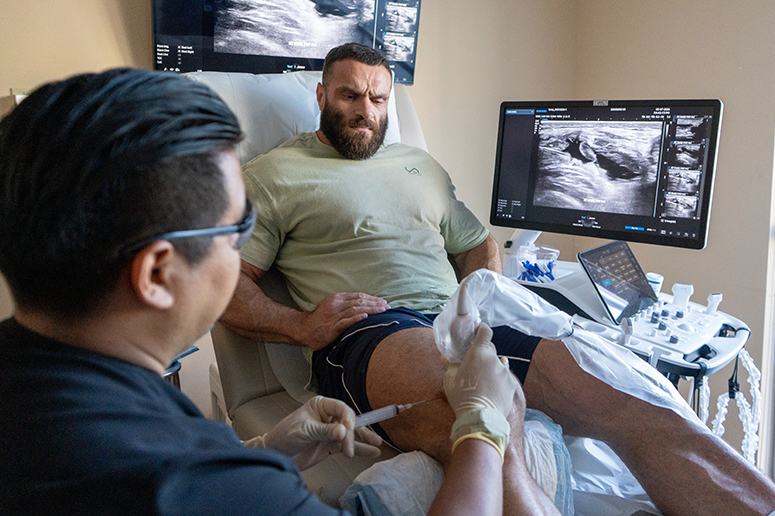
The idea of treatments that can help the body’s muscles, tendons and ligaments heal themselves sounds futuristic, maybe even too good to be true.
But these advanced treatments already exist. They’re helping athletes and other active people heal faster from a variety of sports injuries. They may even help many people avoid surgery.
What Are Orthobiologics?
The field of regenerative medicine is also referred to as orthobiologics. “Ortho” means these therapies are primarily used to treat orthopedic injuries. “Biologics” come from natural substances, typically from your own body.
The name ‘regenerative medicine’ may be a bit misleading. “Orthobiologic treatments don’t directly cause tissue regrowth or repair,” says Giorgio Negron, MD, RMSK, a nonsurgical sports medicine specialist at Memorial Healthcare System. “But they work by encouraging your body’s own healing process.”
Regenerative therapies can help reduce inflammation by stimulating the release of anti-inflammatory messengers. They also introduce growth factors, signaling molecules that tell the body to start the repair processes.
“Substances found naturally in the body, such as blood platelets and cells found in the bone marrow and fat tissue, contain a soup of growth factors and signaling molecules,” says Dr. Negron. “By concentrating these components and delivering them to an injured area, we aim to support tissue healing.”
Types of Regenerative Medicine Treatments
Biologics get their healing powers from tissues and natural substances, many of which are produced by your own body. Some of the more common types of biologics used to treat orthopedic injuries include:
Platelet-Rich Plasma (PRP) Injections
Platelets are small particles in your blood plasma that contain growth factors. By drawing your blood and then spinning it in a centrifuge, the platelets and growth factors become more concentrated.
Injected directly into damaged soft tissue, platelet-rich plasma stimulates and speeds up the repair process. So far, research into the effectiveness of PRP injections has found the greatest benefits for chronic tendon injuries, strained muscles and ligaments, and knee arthritis.
Cellular Therapy
While PRP concentrates platelets and their growth factors from blood, bone marrow aspirate concentrate (BMAC) and microfragmented adipose tissue (MFAT) offer a broader biological toolkit. BMAC is collected from the pelvic bone using a needle, and MFAT is harvested from the belly or thigh. Both are processed to concentrate beneficial components and injected into the injured area.
These tissues contain not only growth factors, but specialized cells that act as signaling hubs that release anti-inflammatory molecules and recruit the body's own repair cells to the injury site. They don't directly rebuild tissue, but they help improve the healing environment. The message: rally the body's own resources to help heal damaged tendons, ligaments, or joints.
Hyaluronic Acid Injections (Viscosupplementation)
Hyaluronic acid is naturally found in the fluid that surrounds and lubricates the joints. When you have arthritis, you have less hyaluronic acid to cushion your bones and help the joints move smoothly.
Viscosupplementation adds hyaluronic acid into your joints to help them feel like they did pre-arthritis. Some people with mild to moderate arthritis report feeling less pain after a hyaluronic acid injection.
Prolotherapy
This treatment involves injecting a dextrose (sugar) and saline solution into a damaged joint. The solution causes irritation, which signals the body to send anti-inflammatory molecules to the area.
Conditions Treated With Regenerative Medicine
Regenerative therapies are still relatively new and not yet proven or approved for all types of injuries. But there is growing evidence that orthobiologics can help heal several conditions, including:
- Cartilage damage, such as labral tears and damage to knee, hip and shoulder joints
- Ligament strains or tears, including the anterior cruciate ligament (ACL) and medial collateral ligament (MCL) in the knee
- Tendinitis, including the Achilles tendon, rotator cuff, and tennis or golfer’s elbow
- Osteoarthritis
Regenerative Sports Medicine at Memorial Healthcare System
If you have a new or nagging sports injury and physical therapy alone isn’t giving you the results you want, you might be a candidate for regenerative medicine.
At Memorial Healthcare System, our sports medicine specialists use a variety of regenerative techniques, including PRP injections, to treat injuries. In many cases, these treatments allow you to avoid surgery and return to your favorite activities sooner and with less pain.
The devices we use to prepare your own tissues are cleared by the Food and Drug Administration (FDA). However, using these therapies to treat orthopedic conditions is considered off-label and hasn't been formally approved by the FDA. Using off-label therapies is a common practice where doctors use their professional judgment to determine the best course of treatment for an individual.
Most insurance companies don't cover regenerative therapies like PRP, BMAC, and MFAT. These treatments are typically an out-of-pocket expense. Our staff will provide you with clear information about the costs associated with your treatment plan before you schedule any procedure.

Medically Reviewed by Giorgio Negron, MD, RMSK
This content has been medically reviewed to ensure clinical accuracy.
Related Providers
-

 Geden Franck, MD Sports Medicine, Non-Surgical Orthopedics (Adult)
 -
 Giorgio Negron, MD, RMSK Sports Medicine, Non-Surgical Orthopedics (Adult)


