
What Knee Replacement Looks Like Today
March 24, 2026

If you watched a grandparent or even a parent go through knee replacement surgery years ago, you may be hesitant to sign on for it yourself.
But if arthritis or knee pain is keeping you from doing the activities you love, you may want to reconsider. Today’s knee replacement surgeries are faster, safer and more effective — and the techniques continue to improve.
“The implants are more customized, the surgery is more precise and the recovery is quicker,” says Daniel Chan, MD, chief of orthopedic surgery and sports medicine at Memorial Healthcare System. “And that means your new knee joint fits better and functions better.”
What Does Knee Replacement Surgery Involve?
 The knee is a complex joint made up of three parts:
- Upper part of the shinbone (tibia)
- Lower part of the thigh bone (femur)
- Kneecap (patella)
Ligaments hold all those parts together, while cartilage cushions the joint and helps it move smoothly.
When any of the knee joint components are worn down by arthritis or damaged by injury, the knee can no longer function as it’s supposed to. Bone rubs against bone, resulting in pain and limited mobility.
During knee replacement surgery, the surgeon replaces damaged parts of the joint with artificial implants. Depending on the degree of damage, you may need:
- Partial knee replacement: Only some parts of the joint are replaced
- Total knee replacement: All the components are replaced with implants
The Advantages of Robotic Knee Replacement Surgery
“The big buzzword in knee replacement surgery is robotics,” says Dr. Chan. “This technology is enabling better, safer and more precise surgeries.”
Using robot assistance, joint replacement surgeons can customize the procedure to exactly match a patient’s anatomy. “Robotics allows you to make tiny adjustments that perfectly align the implant,” explains Dr. Chan.
This process creates a personalized surgery that’s easier to recover from and delivers better results. “With robotic surgery, we can more accurately reconstruct the patient’s knee as close as possible to how their joint worked before they developed arthritis,” says Dr. Chan. “The result is that it feels and moves more naturally.”
Recovery From Knee Replacement Surgery
Knee replacement surgery used to mean several days in the hospital and weeks — or even months — of slow, painful recovery. Not anymore.
“The knee is a more painful joint than the hip, so recovery from knee replacement is a bit more difficult than from hip replacement,” says Dr. Chan. “But the more precise and customized the surgery and the implant, the faster and easier the recovery.”
These advanced surgeries also mean less time in the hospital. Outpatient knee replacements are quickly becoming the norm. With same-day surgery, you can return home within hours of the procedure.
“We use a spinal block and a long-acting nerve block instead of general anesthesia,” notes Dr. Chan. “That provides 24-hour pain relief and lets you go home safely right after surgery.”
Once home, don’t expect to be on the couch 24/7. “You’ll need to limit your step count for the first couple of weeks to minimize swelling,” says Dr. Chan. “But you will be moving, able to go up and down stairs and doing some exercises right away.”
How Long Do Knee Implants Last?
Not only has knee replacement surgery gotten better and more high-tech but so have the implants themselves. Innovative designs and materials are making them more durable, so they function better and last longer.
Most implants are made of metal components with plastic between. The plastic helps cushion the joint and move more smoothly (like the cartilage it replaced).
“Traditionally, implants are bonded to bone with cement, but that can loosen over time,” says Dr. Chan. “For younger patients, we’re now using new cementless techniques to help implants last longer.”
According to Dr. Chan, “You can expect to get at least 20 to 25 years of good knee mobility out of your replacement.”
If knee pain is a near-constant in your life — and you’re sidelined from your favorite activities because of it — it’s time to talk to your doctor. For many, a new knee means a new lease on life.
How Memorial Healthcare System Can Help
The orthopedic specialists in our knee replacement program perform hundreds of knee replacement surgeries each year. Using advanced robotic systems, we customize knee replacement surgery to each patient.
We perform most of our knee replacements at our outpatient surgery and rehabilitation center in Ft. Lauderdale.
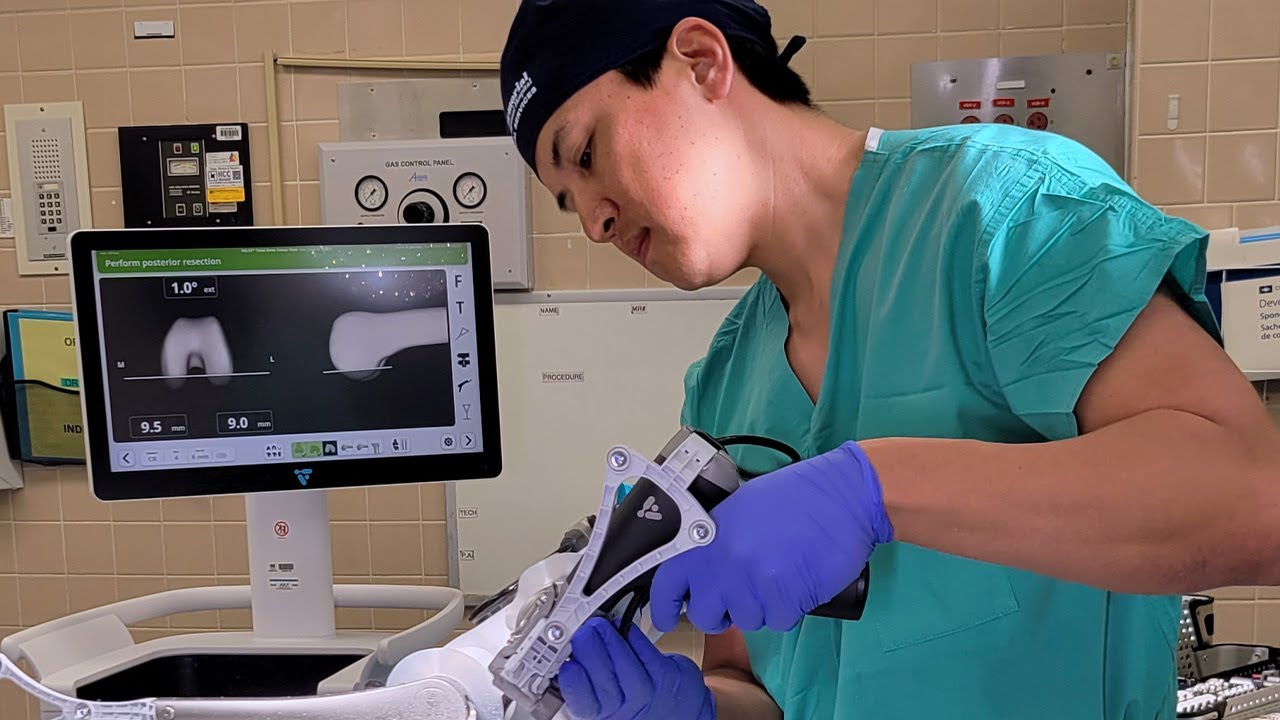
Dr. Daniel Chan Explains New Technology for Precision Knee Replacement


